Detection effectiveness
How to Measure Detection Effectiveness
Leadership asks whether detections work. Dashboards say yes. Incidents, purple-team results, and audit questions often say something else.
Detection effectiveness is the degree to which deployed logic reliably identifies relevant adversary behaviour in real operating conditions. It's measured through outcomes and evidence; a static coverage percentage alone doesn't capture it.
How do you know whether a detection actually works in production? You confirm that declared intent, validation evidence, and live operational outcomes still align for priority threats. How do you measure detection engineering effectiveness? You measure outcome quality, drift, and correction velocity over time within a governed record. Rule counts or mapping breadth taken in isolation don't show that. See the Detection System of Record model.
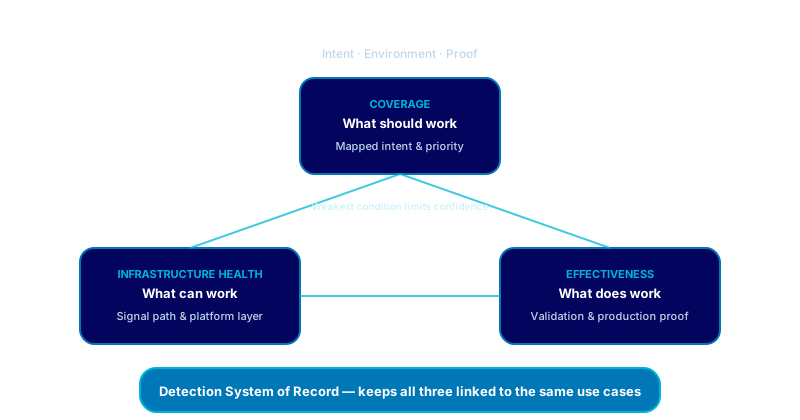
Effectiveness only makes sense when you separate what is declared (mapped and intended), what is validated (proven under test), and what is operational (proven in production). Most programmes collapse those into a single “coverage” number — and that is where confidence breaks.
If use case structure and lifecycle ownership are already in place, this is the next question: does it actually work under pressure? Start from detection use case management or lifecycle management if those foundations are not yet named.
Effectiveness is not the same as lifecycle governance
Lifecycle management maintains ownership, governed state, and traceability over time. Effectiveness asks whether deployed logic still works in production. A use case can pass lifecycle review, have an owner, and sit in the right state — and still fail when tested or triaged under real conditions.
- Lifecycle answers: is the record current and accountable?
- Effectiveness answers: is the detection producing useful outcomes today?
- Strong programmes need both; neither substitutes for the other
See the failure modes model for how lifecycle drift differs from infrastructure degradation and effectiveness decay.
Why effectiveness is different from coverage
Coverage tells you where detections are mapped. Detection effectiveness tells you whether those detections perform as intended in production. Both matter, but they answer different questions. A team can have broad ATT&CK mapping and still fail to detect meaningful activity because validation is sporadic, telemetry is incomplete, or logic has drifted.
| Coverage (intent and mapping) | Effectiveness (production reality) |
|---|---|
| Where logic is intended to exist and how it is prioritised against threat models. | Whether that logic still fires, is useful, and is trusted under current telemetry and infrastructure health conditions. |
| Often summarised as breadth: techniques mapped, rules shipped, use cases in a backlog. | Requires evidence: validation cadence, alert quality, learning loops, and incident-relevant outcomes over time. |
A detection that exists on paper (declared) or passes a controlled test (validated) is not yet proven in production. Effectiveness lives in field performance. Being mapped or demonstrated once doesn't count.
Reliable measurement keeps declared intent, validation evidence, and production outcomes separate. It does not merge them into one headline number.
You need to know whether a detection is still in scope, was tested, has a sound data path, and drives useful incident work. Miss any link and the score is optimistic at best.
This is how programmes end up with controls that pass the lab but miss the wire — reporting stays green while real coverage drifts and the SOC drowns in noise nobody trusts.
This is also where governance discipline matters. Without ownership and lifecycle controls, teams may improve rule volume while effectiveness declines. The right objective is not more detections. It is more reliable detection outcomes against your priority threats.
A practical effectiveness measurement model
A practical model starts with threat relevance. Which attack paths are most likely in your context? Which techniques represent material business risk? Once that scope is defined, each use case should carry declared intent, validated evidence, and live performance signals — lifecycle state, owner, expected behaviour, validation frequency, and known dependencies.
Validation should include both pre-production and production signals. Pre-production evidence might come from BAS or controlled testing. Production evidence should include alert quality, escalation patterns, incident conversion, and false-positive burden. Together, these show whether logic works in theory and under active telemetry.
Teams should also track mean time to correction for failing detections. Effectiveness is not static; what matters is how quickly the program responds when weaknesses are found. Fast, structured correction loops are a strong indicator of detection maturity.
Finally, include Detection Infrastructure Health in your effectiveness lens. If data pipelines degrade, agents fail, logs are malformed, or parsers regress, detection outcomes can collapse even when the detection logic itself is sound. Infrastructure context is therefore not a separate concern; it is part of effectiveness.
Effectiveness checklist
Use this before a board pack or a tool renewal. If you cannot answer with evidence — not a screenshot — the number you are about to report is declared coverage, not effectiveness.
- For each priority threat, is the detection declared — mapped, intended, and owned?
- Has it been validated recently under test (BAS or a controlled scenario), with a date?
- Is the data path healthy enough that production could still carry the signal?
- Do live operational outcomes match that intent — useful alerts, not volume?
- When confidence drops, is there an owner, a target date, and a re-check — not a caveat in email?
These five questions are how you answer Which detections actually work? without guessing. The pattern and the governed record sit on the Detection System of Record.
What leadership actually needs from effectiveness reporting
Executives and boards rarely ask for rule counts. They ask whether priority threats are detectable today, whether assurance claims hold up under scrutiny, and where exposure is increasing without anyone noticing.
Detection assurance — the executive-facing view of effectiveness — requires evidence that connects validation, real outcomes, and correction velocity on the threats that matter. A single green heatmap or SIEM dashboard screenshot is not assurance. It is a belief until incidents or audit test it.
Coverage is a map. Effectiveness is whether the map still matches the territory when someone checks.
Monthly reporting should show trendlines: validated effectiveness on priority techniques, controls that drifted, mean time to correction, and confidence gaps leadership would care about in a breach scenario.
Metric families and what each decision needs
Most programmes mix incompatible numbers into one slide. A clearer model groups metrics into four families, each with a different decision use. Together they answer the question: can we bet on this detection set under current operating conditions? That framing connects naturally to a Detection System of Record because it is the only place the families stay traceable to the same use cases and owners.
- Declared / presence — what is intended to exist and mapped to threat priorities (often where teams stop too early).
- Validated — what you proved in controlled or semi-controlled conditions, with timestamps and configuration context.
- Producer and pipeline health — whether the data path can carry the signal production depends on (often where silent failure hides).
- Production outcomes — alert usefulness, time-to-meaningful-triage, incident conversion, and sustained field performance over time.
If you are measuring only one family, the metric will lie politely: high mapping with weak outcomes still looks defensible in a static deck until an incident tests it. Leadership decisions should be conditioned on the weakest family; the strongest one isn't the constraint that matters.
Correction loops: how you close gaps without adding chaos
The operational rule is simple: every downgrade in confidence needs an owner, a target date, and a verification step. A correction loop is not a ticket; it is a state transition in the same governed object you will show in an audit — which is the difference between “we opened work” and “we restored a defined bar of performance.”
Strong programmes time-box drift: known degradations that exceed a threshold automatically trigger prioritised remediation and re-validation, rather than living indefinitely as caveats. Weak programmes collect caveats in email threads, which is why effectiveness reporting collapses to sentiment.
For a governance narrative that links this loop to threat-informed defense and engineering throughput, return to the hub Detection System of Record after you finish here.
Where SIEM, BAS, and engineering each contribute
SIEM platforms provide core telemetry processing and alerting. BAS platforms provide controlled validation events. Detection engineering provides the logic and tuning discipline. Each function is essential, but none alone provides full effectiveness governance.
Programs that rely only on SIEM metrics often over-value alert quantity or dashboard activity. Programs that rely only on BAS can miss production realities and data-path issues. Programs focused only on engineering throughput can optimize for output volume over outcome quality.
The strongest model links all three: engineering intent, validation evidence, and production behaviour. This linkage creates a stable basis for reporting, prioritization, and executive decision-making.
It also prevents recurring arguments about what “good” looks like. With shared definitions and traceable evidence, teams can focus on improvements instead of debating disconnected metrics.
From effectiveness measurement to a governed record
Effectiveness describes what to measure and what leadership needs to see. At programme scale, those signals must stay linked to the same use cases, owners, and lifecycle state. Scattering them across SIEM dashboards, BAS exports, and quarterly slide decks breaks that link.
A Detection System of Record (DSoR) operationalises this continuously: linking threat context, validation evidence, production outcomes, and correction history in one governed record.
SecuMap implements the DSoR category above SIEM, EDR, BAS, and CTI — without replacing them. If your effectiveness view does not move when validated checks fail or live telemetry breaks, you are reporting declared coverage as if it were production truth. The canonical definition lives on the Detection System of Record hub.
Frequently asked questions
How do you know whether a detection actually works in production?
Confirm that declared intent, validated evidence, and operational outcomes still align for priority threats under current telemetry conditions.
How do you measure detection engineering effectiveness?
By tracking outcome quality, validation evidence, drift, and mean time to correction over time.
How is detection effectiveness measured?
By combining threat mapping, validation evidence, alert quality, and operational outcomes.
Why is detection coverage alone not enough?
Coverage shows logic exists or is mapped. Effectiveness asks whether that logic still fires, produces useful outcomes, and holds up under current conditions.
How is effectiveness different from lifecycle management?
Lifecycle maintains ownership and governed state. Lifecycle management keeps the record accountable; effectiveness asks whether detections still work in production.
What should leadership be told about effectiveness?
Trendlines for validated effectiveness, drifted controls, correction velocity, and confidence on priority threats. A single vanity percentage doesn't tell the story.
How does effectiveness relate to a Detection System of Record?
Effectiveness describes what to measure. A DSoR holds the governed record linking evidence, outcomes, and lifecycle state. See the Detection System of Record hub.