What is a Detection System of Record?
This page defines the Detection System of Record (DSoR) category. For how SecuMap implements the model — operating loop, capabilities, and product workflow — see the Detection System of Record hub.
Start with the pattern
A Detection System of Record makes the distinction between declared, validated, and operational detection explicit—and governed—so the organisation can see which parts of coverage are real, and which are only assumed. It answers, with evidence, whether detection is a managed function: what should be true, what was implemented, what was validated, and what actually happened in operational work.
Modern detection requires aligning multiple sources to a single threat model—and proving effectiveness through live detection signals.
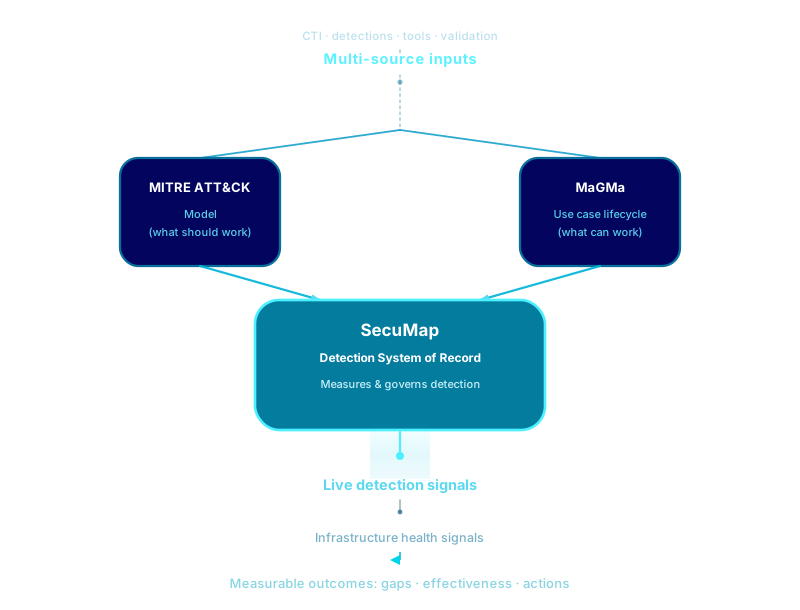
The category view: diverse operational inputs align to MITRE ATT&CK and MaGMa before a governed centre measures coverage and effectiveness through live and infrastructure signals.
Detection is no longer assumed — it is continuously proven.
The three governed conditions
A Detection System of Record governs detection as one capability by answering, with evidence, three questions that programmes typically fragment across tools, teams, and dashboards:
| Question | Governs | Typical failure when siloed |
|---|---|---|
| What should work? | Detection coverage: mapped, prioritised intent—and the gap between declared, validated, and operational truth on the same record. | Fragmented roadmaps: teams disagree on “covered” while executives see one green chart. |
| What can work? | Infrastructure health: whether signal paths and platforms can carry and execute the intent in production. | Rule tuning masks broken telemetry, agents, or parsers; gaps persist invisibly. |
| What does work? | Detection effectiveness: validation and operational outcomes under real conditions. | Effectiveness is reported as SOC sentiment, disconnected from the underlying use cases and owners. |
Together they are governed through an operating loop, so gaps between intent, environment, and outcome stay diagnosable — including when the failure is environmental rather than a logic defect. In one line: what we intend to cover (declared), what tests prove (validated), and what production still shows (operational) stay tied—so coverage is not a static claim but a continuously tested capability.
Without that separation, coverage becomes a story: the rule exists, the map is filled, but nothing proves it still operates the way the board deck implies.
Without all three, detection cannot be reliably governed.
What is a system of record?
Mature business functions use a system of record to represent authoritative state: what exists, what changed, and what is true for the purpose of management and reporting. Sales has systems of record for customer and pipeline state. IT service management has systems of record for incidents, changes, and service health. Finance has systems of record for transactions and the audit trail.
In each case, the system of record is not a substitute for every execution channel. It is the place where the organisation can reconcile work across channels and answer accountability questions with evidence.
This is pattern-level framing: it is not a product category shortcut. SecuMap is not “X vendor for Y” — that kind of comparison collapses positioning into a crowded, feature-led market story.
Why security operations lacks a detection system of record
Security has deep execution systems and strong domain tools. SIEM aggregates telemetry and drives investigations. EDR surfaces endpoint state and many prevention controls. BAS generates validation evidence. CTI enriches adversary context.
The gap is not “more alerts” or “one more product pane.” The gap is a governed, persistent record of detection as a managed capability across the full chain from threat statements to implemented logic, validation, live signals, and learnings.
In most organisations that record is implied by distributed artefacts: backlogs, spreadsheets, wikis, and tickets. That makes outcomes hard to audit, hard to prioritise, and hard to keep coherent when teams, tools, and data sources change.
For a deeper walkthrough of the product category, continue to Detection System of Record (category hub).
The detection fragmentation problem
Detection coverage and detection effectiveness are different ideas, but they are often conflated because the evidence is scattered. A threat team maps behaviours. Engineering ships rules. A validation platform shows point-in-time test results. The SOC triages what fires.
Without a unifying system of record, the programme optimises each step locally: more rules, more tickets, more noise — without a clear picture of which gaps matter, which controls are real in production, and which improvements move risk.
Fragmentation also hides failure modes: stale mappings, unowned use cases, silent drift in pipelines, and “coverage” that is declared but not operationally defensible.
What a Detection System of Record is
A Detection System of Record fills the governance gap above execution tools. The canonical category definition is:
A vendor-neutral governance layer that continuously maps threat intelligence to detection coverage, measures detection effectiveness, and governs detection health across the full threat-to-detection operating loop.
How it works across the operating loop
A Detection System of Record keeps threat, validation, build, live operation, and learning on one governed object — declared intent, validated evidence, and operational outcome, not three disconnected narratives. The product hub has the threat-to-detection operating loop and the failure-mode model; this page stays on the category pattern.
Unlike systems of record in some other domains, a DSoR does not replace the execution systems beneath it; it coexists with them and should integrate into how engineering and operations already work.
How it differs from SIEM, BAS, and CTI
SIEM executes detection over telemetry, routes alerts, and helps investigators search and correlate. BAS simulates techniques and provides validation evidence. CTI enriches adversary tradecraft and context.
A Detection System of Record is not a substitute for those layers. It is the place where the organisation can answer cross-tool questions: what the programme intends to cover, what is live, what has been tested, what is failing, and what should change next — with accountability and measurable outcomes.
For a compact comparison table of adjacent domains, see category boundaries on the product hub. Dedicated compare pages: SIEM vs Detection System of Record, SOAR vs Detection System of Record, EDR vs Detection System of Record, XDR vs Detection System of Record, and BAS vs continuous validation in governance.
Why it matters: governance, evidence, accountability
Boards, regulators, and your own red-team findings care about one practical outcome: the organisation can show how detection is owned, how gaps are triaged, and how improvement is tracked over time.
A DSoR is how you move from a collection of good tools to a governed capability with a credible record: what was decided, what was built, what was tested, and what the operation proves in production. Most organisations already track detection content; what they lack is a governed view of which detections are merely declared, which are validated, and which are actually operational in production, with the same owners and use cases. Detection coverage, infrastructure health, and detection effectiveness are where programmes most often leak credibility when treated in isolation; the system of record keeps all three tied to the same use cases and owners.
Where SecuMap fits
SecuMap is a product that implements the Detection System of Record category — a platform you deploy in your environment, operating alongside SIEM, EDR, BAS, and CTI without replacing them.
For the operating loop, capability model, failure modes, and category boundary table, continue to the Detection System of Record hub. See platform views for day-to-day workflow, or the interactive demo before you deploy.
Frequently asked questions
What is a Detection System of Record?
A vendor-neutral governance layer that continuously maps threat intelligence to detection coverage, measures detection effectiveness, and governs detection health across the full threat-to-detection operating loop.
Why does security need a Detection System of Record?
Security has strong execution systems (SIEM, EDR, BAS, CTI) but often lacks a single governed record of what should be detected, what is live, what has been validated, and what incidents prove. A DSoR fills that gap without replacing those systems.
How is a Detection System of Record different from a SIEM?
A SIEM executes over telemetry and drives investigations; a DSoR governs the cross-tool model of what is intended, deployed, tested, and observed — above the SIEM. See SIEM vs Detection System of Record for a direct comparison.
Is this the same as a “security platform” story?
No. A Detection System of Record is a category and governance function. SecuMap implements that function as a platform, but the identity is the DSoR. It isn't a generic “security platform” market slot.
Does a DSoR require replacing my SIEM?
No. A DSoR operates above execution and validation tools, integrating to what you already use so you can govern lifecycle state and health without forcing a tool rip-and-replace.
Next steps
You have the category pattern — next, see how SecuMap implements it as a governed platform.
Get started free See it in action
Product and operating model: Detection System of Record hub.