Threat model
What is MITRE ATT&CK?
MITRE ATT&CK is a globally recognised framework that describes how real-world adversaries behave. It provides a structured way to understand tactics, techniques, and procedures (TTPs) used in cyber attacks.
But while ATT&CK gives organisations a common language for threats, it does not provide a system for managing detection coverage, measuring effectiveness, or driving continuous improvement.
How do security teams map detection rules to MITRE ATT&CK? Start with ATT&CK technique intent, map rules and procedures to those techniques, then keep that mapping connected to validation evidence and production outcomes so it stays operational rather than static. The operational synthesis is a Detection System of Record.
What is MITRE ATT&CK?
MITRE ATT&CK (Adversarial Tactics, Techniques, and Common Knowledge) is a publicly available knowledge base of adversary behaviour.
It organises cyber attacks into:
- Tactics — the objective of an attack (e.g. Initial Access, Persistence)
- Techniques — how that objective is achieved
- Procedures — real-world implementations observed in the wild
This structure allows security teams to map threats in a consistent and repeatable way.
Why organisations use ATT&CK
ATT&CK has become a standard across security operations because it enables:
- A shared language between teams (SOC, CTI, detection engineering)
- Threat-informed detection design
- Mapping of controls and coverage to real-world adversary behaviour
- Alignment between tooling (SIEM, EDR, BAS) and threat models
It is widely used to create ATT&CK heatmaps, showing which techniques are covered.
The limitation: ATT&CK is not an operational system
ATT&CK is powerful — but it is often misused.
Most organisations rely on:
- Static heatmaps
- Manual mapping exercises
- One-off assessments (purple team / BAS)
These approaches create visibility without validation.
They do not answer critical questions:
- Which detections actually work?
- Do they trigger on real threats?
- Are they noisy, broken, or never firing?
- How has coverage changed over time?
This leads to a false sense of confidence.
Teams think they have coverage — but they don’t know if it actually works.
The gap: from mapping to measurement
ATT&CK defines what should be detected. It leaves the following undefined:
- How detections are managed
- How effectiveness is measured
- How improvements are tracked over time
This is where many security programmes stall.
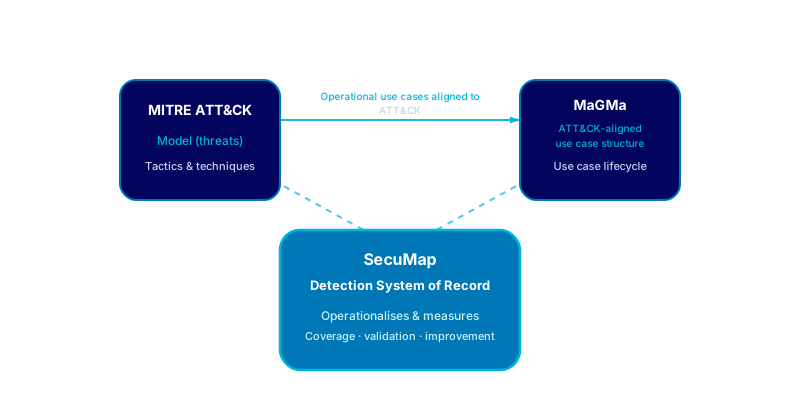
From ATT&CK to a Detection System of Record
To move beyond static mapping, organisations need a system that:
- Links ATT&CK techniques to actual detection rules
- Tracks how those detections perform in the real world
- Continuously validates effectiveness
- Provides a persistent view of detection coverage
This is exactly the gap a Detection System of Record is designed to solve.
ATT&CK is the model. DSoR is the system.
ATT&CK → defines threats
DSoR → measures detection
How SecuMap uses MITRE ATT&CK
In a modern detection programme:
- MITRE ATT&CK defines what to detect
- MaGMa defines how detections are managed
- SecuMap (DSoR) makes both measurable and operational
SecuMap uses ATT&CK as the threat model layer:
- Every detection is mapped to ATT&CK techniques
- Coverage is measured continuously through live detection signals rather than static mapping
- Validation results are tied back to techniques
- Gaps are identified based on real-world effectiveness
ATT&CK becomes:
Not just a mapping framework — but a measurable part of an operational system.
Bringing ATT&CK to life
On its own, ATT&CK answers:
“What should we detect?”
SecuMap extends this to:
- What are we detecting?
- Which detections actually work?
- Where are we exposed?
- What should we do next?
Frequently asked questions
How do security teams map detection rules to MITRE ATT&CK?
Link ATT&CK techniques to owned use cases, map procedures and deployed logic, then keep mappings current with validation evidence and production outcomes.
Does MITRE ATT&CK measure whether detections work?
No. ATT&CK defines adversary behavior and mapping structure. Production measurement still requires detection effectiveness evidence and governed lifecycle links.
Why are MITRE ATT&CK heatmaps not enough?
Heatmaps show mapped intent, but they do not confirm whether deployed detections still work in live conditions or whether drift has weakened outcomes.