Detection System of Record vs Detection Posture Management
Direct definition: DSoR is a governance system of record; detection posture management is a related market framing for assessing detection condition.
Not to be confused with: Category replacement. These models can overlap, but DSoR emphasises persistent governed record and lifecycle evidence.
Best for teams who: Need to decide whether posture views alone are enough or a full governed record is required.
Both approaches seek better detection outcomes. The key difference is whether the programme has a persistent system of record connecting threat intent, validation evidence, and live operational proof.
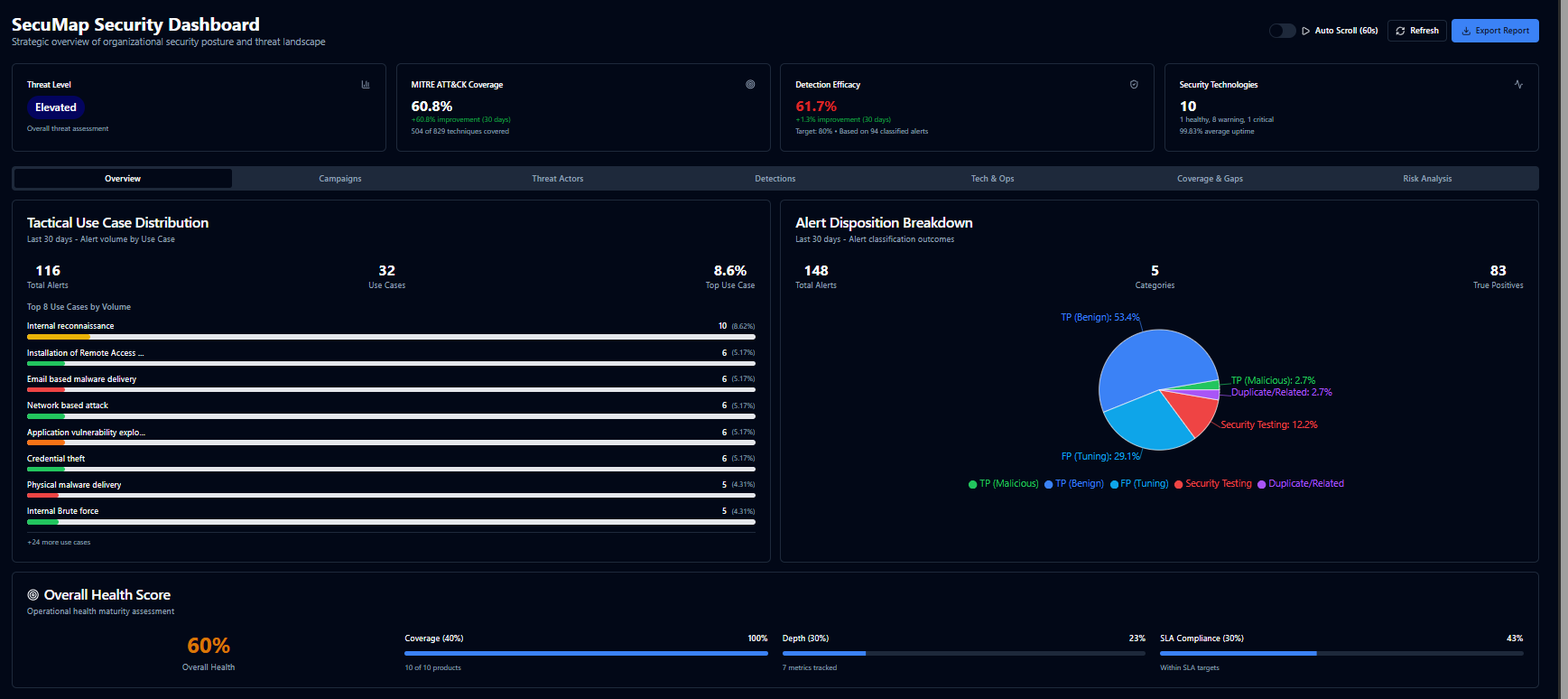
SecuMap applies the DSoR model to make threat-informed detection governance auditable and continuously improvable without replacing your SIEM, EDR, BAS, or CTI stack.
| Focus area | Operational expectation |
|---|---|
| Primary emphasis | Detection posture management focuses on condition visibility; DSoR focuses on governed lifecycle continuity. |
| Evidence model | DSoR tracks declared, validated, and operational state with ownership and audit trail. |
| Decision horizon | Posture model supports current-state optimization; DSoR supports lifecycle governance and strategic prioritization. |
| Operating outcome | DSoR supports defensible remediation decisions based on continuous operational proof. |
How to decide
Choose Detection Posture Management if...
You mainly need visibility into current detection condition and short-cycle posture tuning.
Choose DSoR if...
You need one governed record connecting threat mapping, coverage expectations, validation evidence, and production outcomes.
Choose both if...
You want posture metrics as operational inputs but still need governance continuity and auditable lifecycle decisions.
Frequently asked questions
Are DSoR and Detection Posture Management mutually exclusive?
No. Detection posture management can provide useful condition metrics, while DSoR governs continuity from threat intent to operational outcomes.
When is detection posture management enough on its own?
It can be enough for teams primarily optimising visibility of current detection condition, without a requirement for end-to-end governed evidence continuity.
When is a Detection System of Record required?
A DSoR is required when leadership needs auditable continuity across threat mapping, validation, ownership, and production outcomes.
Can teams use both models together?
Yes. Posture metrics can be inputs while DSoR provides the governance model that connects those inputs to lifecycle decisions.
Does SecuMap support posture metrics?
Yes, but inside a broader governed record model to reduce false assurance from isolated posture views.