Threat Intelligence Mapping
Direct definition: Map threat intelligence to ATT&CK coverage expectations, validation evidence, and operational detection outcomes.
Not to be confused with: Feed aggregation alone. Intelligence mapping governance tracks whether mapped threats are detectably covered.
Best for teams who: Need to turn intelligence priorities into measurable detection decisions.
SecuMap applies Detection System of Record (DSoR) governance so CTI priorities remain connected to coverage expectations, validation evidence, and operational outcomes.
Threat intelligence mapping ensures threat hypotheses connect to specific detection expectations, owners, and evidence paths.
SecuMap governs this mapping loop so teams can prove which priority adversary behaviours are operationally detectable right now.
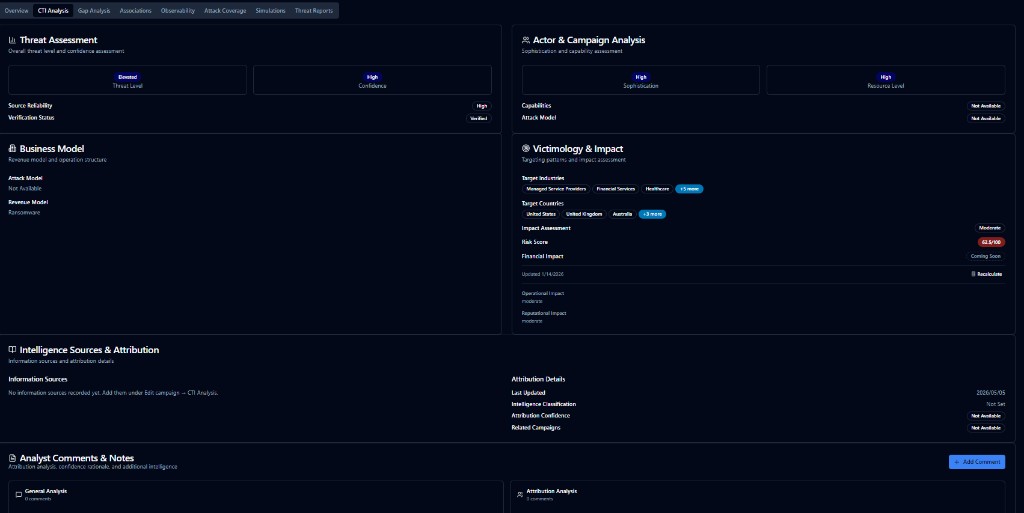
Product evidence: CTI analysis and victimology
Campaign intelligence starts in the CTI Analysis view: threat assessment, actor and campaign analysis, business model context, and victimology with impact scoring. This is where analysts decide whether a campaign is relevant to your watchlist industries, geographies, and risk posture before any detection work begins.
Product evidence: campaign-to-detection workflow
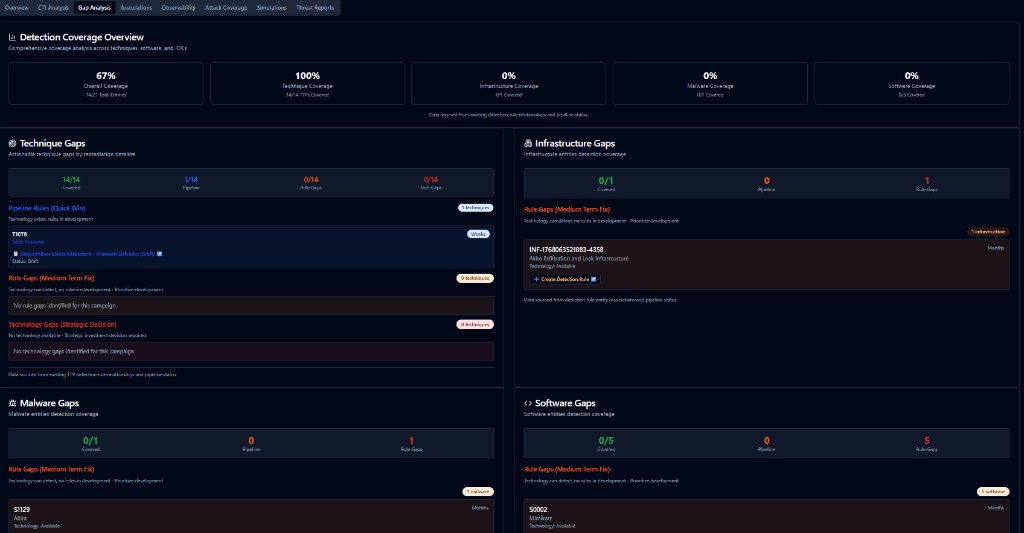
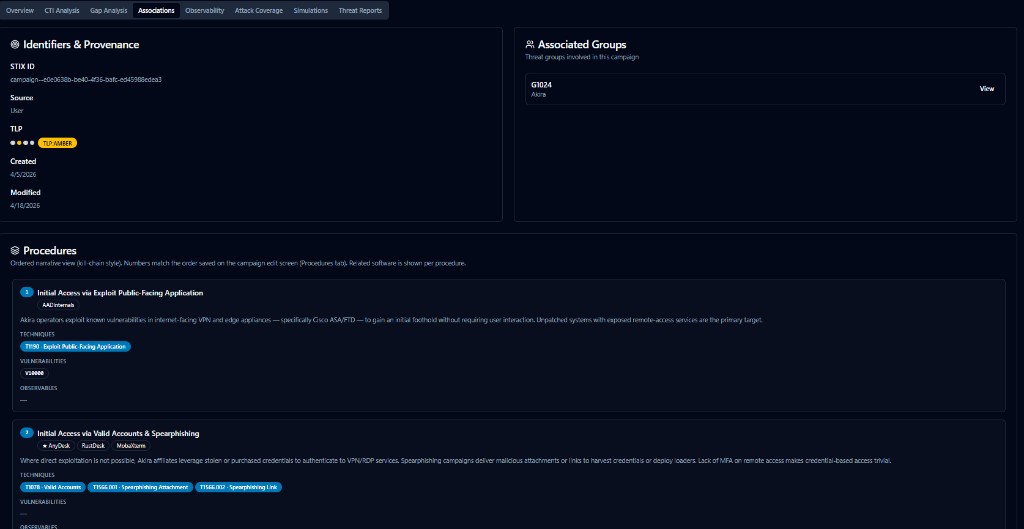
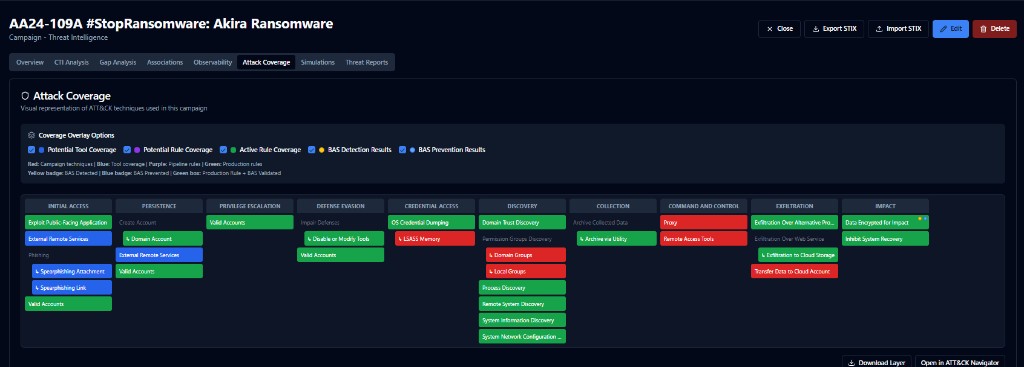
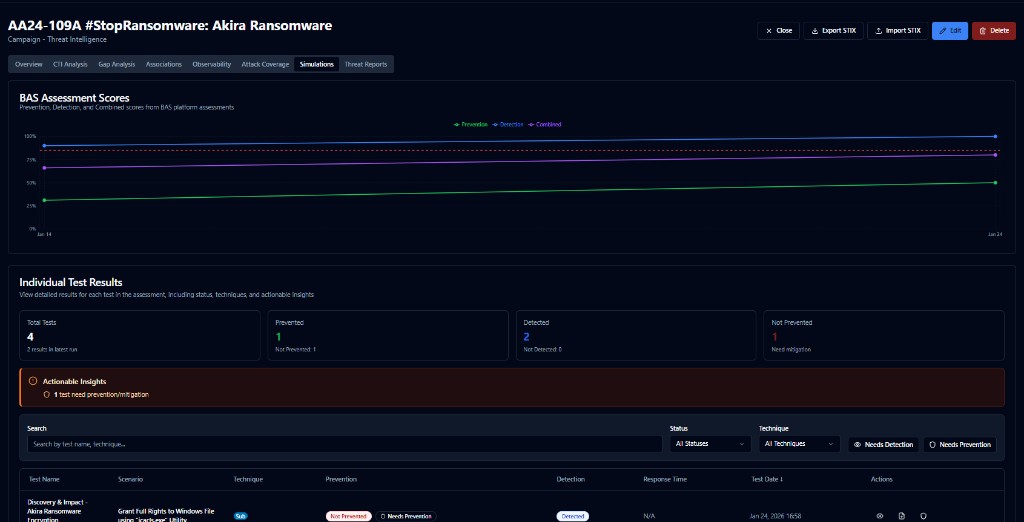
From CTI analysis, SecuMap moves through gap analysis, campaign associations and procedures, ATT&CK navigator-style attack coverage with BAS overlays, and simulation results over time. At each stage you can act on gaps — pipeline quick wins, create detection rules for rule gaps, tune prevention, or reassess after BAS. Campaigns import and export via STIX in the UI, or integrate through webhooks for repeatable CTI-to-detection workflows across teams and external platforms.
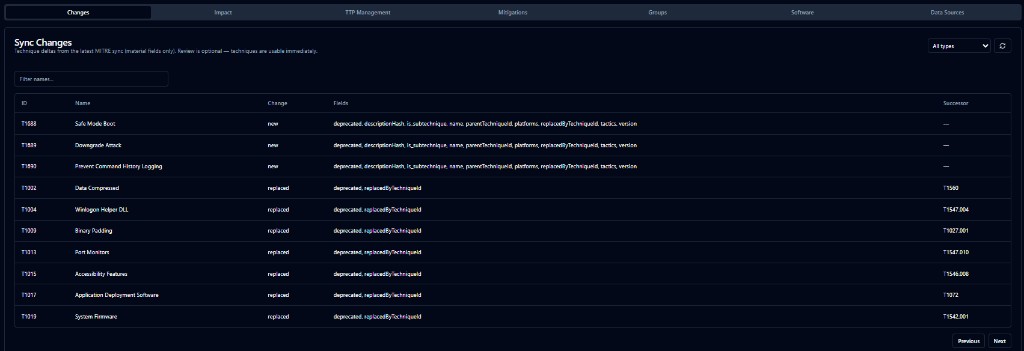
Product evidence: ATT&CK change ledger
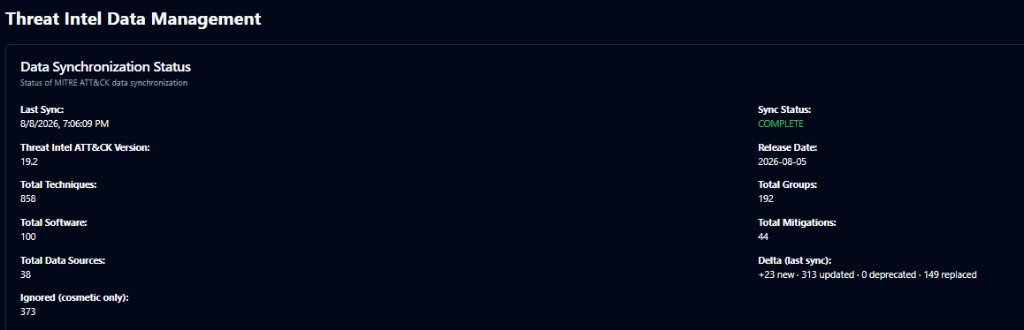
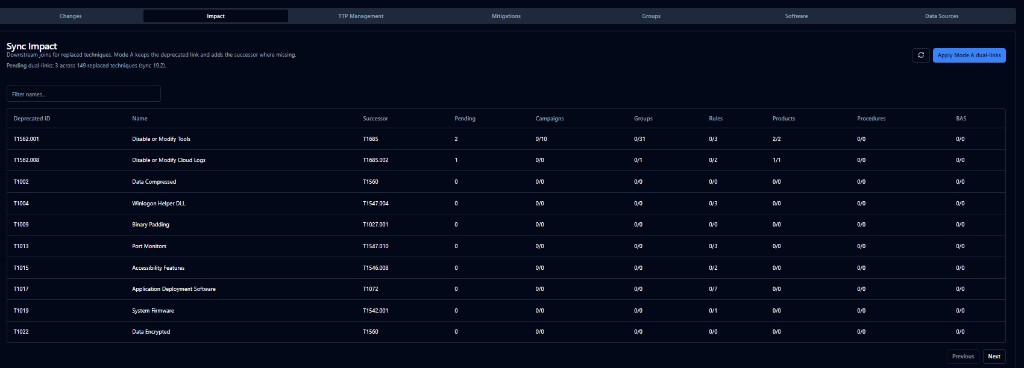
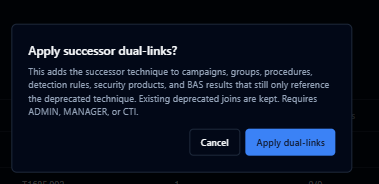
When MITRE ATT&CK itself changes, SecuMap records the sync, lists new and replaced techniques, and shows which detections still need successor links before you apply them. Coverage stays tied to the current ATT&CK version through that ledger and impact review — not a static heatmap export.
Campaigns support STIX import and export from the campaign UI, and webhook-based exchange for automated CTI ingestion or handoff to external platforms — keeping intelligence, coverage, and detection engineering aligned in one governed loop.
| Focus area | Operational expectation |
|---|---|
| Threat hypothesis | Priority intelligence is mapped to ATT&CK techniques and use-case ownership. |
| Detection expectation | Mapped threats are linked to deployed logic and validation schedule. |
| Operational proof | Live outcomes and drift evidence confirm or challenge confidence assumptions. |
Frequently asked questions
Is this a threat intel platform replacement?
No. It governs how threat intelligence is translated into measurable detection capability.
What does this improve for security leaders?
It improves prioritisation by linking threat focus to operationally proven detection outcomes.
How does this connect to ATT&CK coverage?
Each mapped threat is tied to ATT&CK techniques and governed detection evidence.